

Words Matter
A little louder for those in the back

Last Friday, while at a writer’s conference, I sat in a circle in a college classroom as writers introduced themselves and their stories. One very lovely woman, we’ll call her Suzy, is writing about mothering a son who suffers from the disease of alcoholism*. If I could have high-fived her across the room, I would have. I applaud anyone willing to be vulnerable, especially when telling stories that sometimes invoke shame.
As she explained the premise of her memoir, she said, “We learned that my son was a raging alcoholic.”
I winced at “raging alcoholic.” I knew what she meant. Her son was in the throes of his disease—lying, stealing, destroying relationships, wreaking havoc in her family’s life. But the choice of “raging” felt belittling. I get it, though. When her son was an active alcoholic, his behavior caused real harm. He was raging, but can a disease be raging? Would we say, “My son was a raging cancer patient”?
Then, a day later, I sat in a library’s auditorium for a reading and conversation with one of the conference’s faculty, David Joy. (He is a public figure, so I feel okay to name him.) He writes novels “exploring themes of nature, addiction, and the human condition, inspired by his home state of North Carolina.” I’m not familiar with his work, but I purchased one of his novels and added it to my ever-growing TBR (to-be-read) pile.
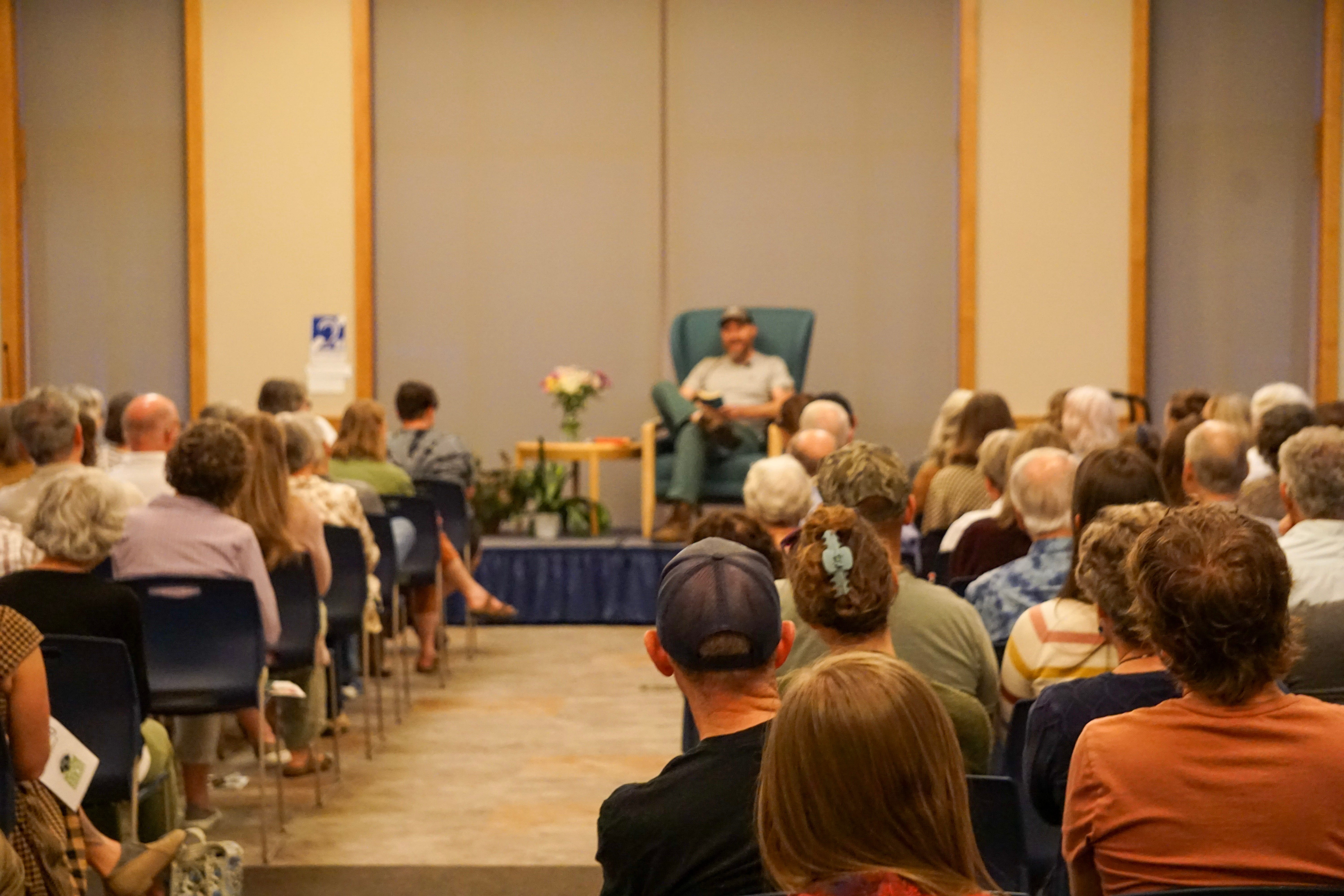
From the stage, he talked about how the opioid crisis was ravaging his neighborhood. He said that a “junkie” showed up on his porch asking for needles. Again, I winced at “junkie.” And again, I know why he chose that word. It quickly described a person in the throes of their addiction. Guant and gray. Eyes glassy. Maybe dirty. And unpredictable, which makes them scary.
But “junkie” is most definitely a disparaging word. I knew from the context of his speech that Joy was empathetic about the disease of addiction. Yet, he still used this hurtful, dehumanizing word to describe someone suffering from a disease.
WORDS MATTER.
I’ve spoken about this topic before when I received feedback from a friend about the word “addict.”
My friend said, “I encourage you not to use the word ‘addict.’ It’s pejorative and research shows (even when intent is positive) that it’s a highly stigmatized term.”

I try to pass on that education whenever I can. In one of our many deep conversations, my friend Kelly said, “What am I supposed to say instead of ‘addict’?”
“She suffers from the disease of addiction.”
“That’s a mouthful,” she responded.
Yup, and yet we should still do it.
Take, for example, the phrase “died by suicide” instead of the more common “committed suicide.” When I learned that “committed” implies criminality and carries a moral judgment, I made a conscious effort to change. Saying “My sister died by suicide” wasn’t easy. (Well, talking about my sister’s suicide in general wasn’t easy.) At first, the phrasing felt weird, and I felt like it was calling more attention to it than I wanted. But say that wording enough times, and it feels like the normal thing to say.
Oh, wait, and one more thing about the words we choose. Yesterday, an author I admire said in a Substack note, “Both my cats are shrieking at the top of their lungs while I’m trying to write and I’m ready to stick my head in the oven.”
As someone who lost a loved one to suicide, joking about suicide also makes me wince. Can’t we think of something else to indicate we are frustrated instead of saying we want to kill ourselves? Can we try to choose our words more thoughtfully? Of course, this isn’t easy, and it takes commitment to the new phrasing and pausing before we speak, but I do think it’s worth it. Don’t you?
Which brings me back to Suzy writing a memoir about parenting a child in the throes of his disease. I truly hope she continues to write this story. Honest personal narratives about the diseases of alcoholism and addiction will continue to create empathy and awareness. And this awareness will help us all to be thoughtful in our word choices.
*BTW, Grammarly repeatedly told me to delete “the disease of” before “alcoholism.” No, Grammarly, that’s my whole point.
ADDENDUM: As a courtesy, I forwarded a draft of this post to “Suzy” before publication. She responded with this:
“Ugh, I regretted that [using raging alcoholic] the moment I said it in workshop. I’d been nervous at the thought of quickly sharing the topic of my work, and even as the word left my lips, I’d wished I hadn’t. I believe I have never before used that term in reference to my son or any other person, and at that nanosecond in my introduction, I was thinking I needed to pick up the pace of my story, so I shortchanged him. I regret doing that.”
I so appreciate her thoughtful response. She didn’t get defensive but understood my position and even agreed with me. She added to the “addict” discussion by saying this:
“In the particular case you mention, which involves the word ‘addict,’ I’d even take the reasoning a step further. In the usage you mention, the term ‘addict’ is being used in place of the person. A person may be ‘addicted,’ or they may be ‘in recovery,’ but the construction should always posit the person as a person, not as something else.”
Yes, Suzy! Leave it to writers to really dig in on the language. Thanks for the further enlightenment on that wording choice. May we all be careful when choosing our words.
Disclaimer: To err is human. Please excuse any typos or grammatical errors.
Thanks for this thoughtful essay. I am always grateful when corrected on some aspects of speech (well, defensive at first, but eventually grateful). When I first moved down south to Savannah, during my training at a local museum I was corrected from referring to some as a “slave”—instead told to say “enslaved person.” The difference surprised me and it made me wonder about other phrases and forms of language that I use, ways of speaking that have hidden subtexts. I know some people feel censored by the “word police” but I think of it as necessary verbal calisthenics- the need to grow stronger in our ability to communicate with each other- really it is what holds the world together.