

Reading for Empathy
Two personal stories to help us all understand addiction better.

Hiya readers! Last night, I reviewed what I wrote for this week’s post, and, well, it’s blech. I’m just not feeling it. Rather than share something subpar, I thought I’d share some excellent writing about addiction that I’ve recently read.
First, a memoir
(As a memoir writer, I read a lot of memoirs!)
The Many Lives of Mama Love Club: A Memoir of Lying, Stealing, Writing, and Healing
by Lara Love Hardin

The Amazon description says:
“New York Times bestselling author Lara Love Hardin recounts her slide from soccer mom to opioid addict to jailhouse shot caller and her unlikely comeback as a highly successful ghostwriter in this harrowing, hilarious, no-holds-barred memoir.”
I listened to this memoir on Audible. That’s how I “read” most books these days. And it was one I turned on every time I had to drive my son to class or pick my daughter up from work. Meaning even if I only had 15 minutes, I would listen to the book, which is a sign I like the book. I even lay in bed with my headphones “reading,” which always feels silly to me but must be done sometimes when you choose to listen to a book. My point is that I was interested in Love’s story.
Love had a “low bottom,” which is a term we use in the rooms of recovery to say things got really, really bad before she stopped using drugs. She went from a suburban PTA mom to spending a year in jail and losing custody of her son.
What I found enlightening was the near-impossible hoops she had to jump through to accomplish all her parole requirements. And she was a white woman with some access to money, but even still, the requirements of her release seemed purposely set up to make her fail and end up back in jail.
The other theme that stood out for me was the judgment from her neighbors and the shame Love felt from her actions while she was in active addiction. Yes, she stole credit cards, and most definitely, she should do the time for her crime, which she did. But her neighbors showed up at her trial and vilified Love with glee.
We have a saying in AA. “The only time you should look down on someone is when you are extending a helping hand to them.” It's not about judging someone for their past actions, but rather seeing them as someone who needs support to overcome their challenges.
This memoir is a “comp title” for me, meaning it’s similar to my memoir SOBER MOM, forthcoming from She Writes Press in Spring 2026. (Did I just drop that bombshell publishing news in a post that probably no one is reading? Yes, I did! More to come on that!)
Anyhoo, it’s a good read if you want to get inside the mind of a person suffering from addiction and gain empathy for those who are trying to rebuild their life after getting sober.
Next, an essay
“I Lost My Son to Addiction. No Privilege Didn't Protect Him”
By Scott Oake
Published January 25, 2025, in The Walrus
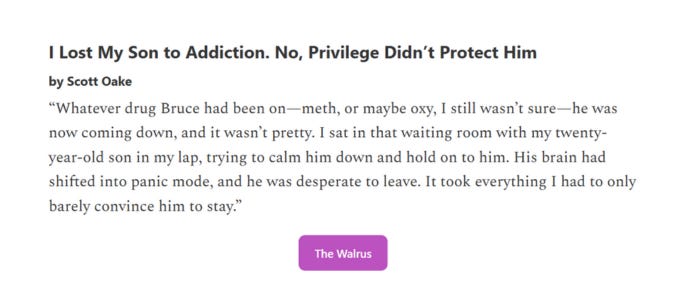
Similar to Love’s memoir, this personal essay written by Scott Oake and published last month in The Walrus discusses addiction but from the side of a parent trying to get their child clean. The whole read is heart-breaking but here’s the paragraph that really packs the most punch for me:
Most Canadians understand, by now, that addiction is a disease. And yet individual addicts are still blamed for it, as if it were simply a matter of making better life choices. But who grows up dreaming of being a drug addict? Who would choose to live a life full of such pain and desperation? Nobody. Bruce certainly didn’t. But he fell victim to it anyway.
On a weekly basis, I’m astonished by the “normies” (meaning people who don’t suffer from alcoholism and addiction) in my life who still don’t understand that it’s a DISEASE. Smart and empathetic people who don’t understand that when a person is in active addiction, it’s the disease that’s making them act badly. I discuss this in my previous post, Defending My People.
My friend Mariel said it best: “But because of the legitimate harms a person with addiction or alcoholism causes, there is a stigma with these afflictions, and sufferers are treated with disdain instead of compassion.”
One way to understand someone else’s life and struggles is to read about them, which is why I LOVE personal stories. So, I encourage you to read Oake’s essay about his son or Love’s memoir about her addiction struggles. Let’s gain some empathy by sharing each other’s stories.
Disclaimer: I wrote this post in half an hour at 6 a.m., so I’m sure there are some mistakes. Please excuse any typos or grammatical errors.
Congratulations on your memoir! So exciting!! These recommendations sound so compelling. Thank you for sharing!
Liz! Congratulations on your memoir! That’s wonderful news!!! 👏👏👏👏